
Optical Fiber Ribbons in the Premises Network
By: Herb Congdon, Siecor
Contents
Cable installations
What's available?
Ribbon termination procedures
What about standards compliance?
So, what's the catch?
Understanding how to get the most benefits from using fiber ribbons instead of single fibers is important for customers, contractors, and installers of premises networks. Further, understanding how the fiber ribbon option will affect your installation will minimize the effects of any differences associated with ribbons.
Cable installations
Telcos and CATV installations typically install optical ribbon cables on long, point-to-point cabling runs that require several splice points. Deploying ribbon cables minimizes the splice time required at each of these cable junctions. On the other hand, splice points in a private network installation are uncommon, so to be considered viable optical ribbons must provide additional advantages that meet the needs of private network architecture.
Campus backbone cabling is a logical deployment location for ribbon cables since these locations usually have the highest fiber count that are installed in ducts, and typically are run directly from one termination point to another. Here, the greater packing density and smaller cable minimum bend radius will allow maximum flexibility for a high fiber count run. Once inside the building, the ribbon cable is quickly terminated, particularly if the building backbone cables are ribbon cables.
In the building backbone network, ribbon cable offers the advantages of quick termination and simple fiber drops to downstream closets. At each drop location, preconnectorized cable assemblies or prestubbed modules offer easy transition from ribbons to single fibers or fiber pairs. With specialized pulling grips, connectorized ribbon cables can be pulled into place and quickly installed into optical hardware. Furcation kits used to transition from ribbon to single-fiber cables are available as well.
In the horizontal, two-fiber ribbons support the transmission and return paths while offering the convenience of a single, symmetrical package. Two-fiber ribbon cables are usually round, as compared to a zipcord or flat cable. Two-fiber ribbon cables can be quickly prepared and connectorized simultaneously. (see Figure 1). Twelve-fiber ribbon interconnect cables are also available, and make an excellent choice for centralized and open office cabling.
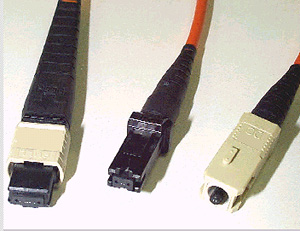
Two-fiber and 12-fiber ribbons, with single-mode and multimode fibers, are most popular for installations. While 24-fiber single-mode ribbons would offer telcos considerable packing density advantages and are under consideration, there are no 24-fiber ribbon mass fusion splicers.
What's available?
Ribbon cable designs for almost every application are available now. Outside plant, inside plant, interconnect, and indoor/outdoor designs have been installed. Flame retardant ribbon cables are available in plenum (OFNP) and riser (OFNR) versions. Surprisingly, there is little to no price difference between ribbon cables and their single-fiber counterparts. In fact, some ribbon cable designs are actually less expensive.
Twelve-fiber ribbon connectors are currently available as connectorized cable assemblies and as pre-stubbed assemblies. Field-installable versions will probably be available in the near future. Multi-fiber connector designs are available in one or more of the following versions: fast field-installable (no epoxy, no polish), epoxy and polish (so-called "bag of parts"), and connectorized cable assemblies. Prices for multi-fiber connectors are extremely competitive. While there will be a price premium as compared to a single-fiber connector, the premium will be less than purchasing an equivalent number of single-fiber connectors.
In short, everything needed to install a complete ribbon cable plant is available.
Ribbon termination procedures
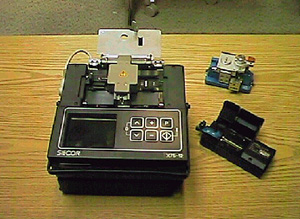
For the most part, ribbon cables and single fiber cables are installed using the same procedures. Heat, instead of a mechanical stripper, is used to remove the ribbon matrix, color, and coating from ribbonized fibers. The fibers are simultaneously cleaved, and then mass fusion spliced or connectorized. The tools required for stripping and cleaving ribbons are different, but are all of a similar size as the tools for single fiber splicing. (see Figure 2). These tools also are readily available for purchase or rent. The tools capable of handling 12-fiber ribbons can handle other ribbons, as well as single fibers.
What about standards compliance?
TIA-568-A does not list requirements for cable construction, only for fiber performance. Optical fibers in ribbons will meet these requirements for singlemode and multimode optical fiber. TIA-568-B (in draft) lists ICEA 596 and ICEA 640 requirements for cable performance and testing. Optical ribbon cables are available which meet these standards. Sacrifices in fiber and cable performance should not be necessary when purchasing ribbon products.
Multiple-fiber connectors, while not approved in TIA-568-A, are allowed in the draft version of TIA-568-B. Due to the incorporation of these multi-fiber connector designs with transceivers from numerous electronics vendors, these kinds of connectors are sure to become more and more popular in the future.
So, what's the catch?
There are some trade-offs for going with optical ribbons, although most are offset by the advantages that ribbons offer. As previously discussed, however, there is not a significant price penalty.
However, due to the fixed V-groove fiber alignment mechanisms used in mass fusion splicers, the typical splice loss will be slightly higher for spliced ribbons than for spliced single fibers. Similarly, connector losses may be higher, but these differences are on the order of only a few hundredths of a dB. Losses compliant with TIA-568-A are easily achievable.
Heavy-handed installers who stress cables beyond the manufacturer's recommendations are likely to see higher attenuation deltas with ribbon cables before seeing similar problems with stranded loose tube cables subjected to the same stresses. As long as the manufacturer's recommendations are followed, however, there should be no problems.
Also, any time that a ribbon has to be split into individual fibers, some form of furcation kit will be needed, unless the installer uses preconnectorized assemblies or pre-stubbed hardware. The correct tools for splicing and that particular connector tool kit will be needed as well.
Summary
The advantage in ribbons results from the capability to handle multiple fibers simultaneously. Accordingly, the best way to reap the most benefits from the ribbon option is to plan the installation using ribbons and multi-fiber connectors throughout the network.
Payoffs can be substantial. New products, new technologies, and new procedures are available and more are being developed. This is why you can expect to see more ribbons in premises networks
About the Author:…
Herb Congdon is a supervisor in Siecor's Applications Engineering Department. He is a registered professional engineer.