
Fiber Optic Connector And Mechanical Splice Global Market And Technology Forecast
Tokyo, Japan and Upper Lake, CA — Electronicast Consultants, a market & technology forecast consultancy addressing the fiber optics communications industry, has announced the release of a new market forecast study of the global consumption value and technology trends of communication fiber optic connectors and mechanical splices in selected communication applications.
"The global connector/mechanical splice consumption is driven by a dramatic increase in bandwidth demand beyond the limits of copper. Technological advances in fiber optics are assuring the migration of fiber closer and closer to the end user. This translates into demand for shorter links where connectors represent a substantial share of the total installation cost. The cost concerns are being addressed with the introduction of smaller, lower cost and easier to install connectors. Multifiber connector (>2 fibers) use, still relatively small, will be the choice for high fiber density interconnect applications," states Stephen Montgomery, director of the study.
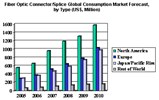
The global fiber optic connector and mechanical splice consumption last year (2005) was $1.2 billion. The consumption value will increase with strongly rising quantity growth partially offset by declining average prices. By the year 2010, the worldwide consumption value is forecasted to reach $3.7 billion.
North America Leads in Global Consumption
North America led in global consumption with 46 percent or $554.5 million in 2005. North American consumption will expand in value to $1.58 billion by 2010, as illustrated in Figure 1.1.1. North American connector consumption will be driven by the proliferation of relatively shorter links used in private data and local loop networks. European connector consumption, 24 percent in 2005, is led by the European Union member states as they transition to open competition in delivery of broadband services to business, as well as residential customers. The fastest growth in connector consumption will occur in Japan/Pacific Rim and the Rest of the World (including South America) regions stimulated by favorable national economic policies and the trend toward telecom liberalization.

SOURCE: Electronicast Consultants