
Alcatel's new OXC leverages bubble technology
By Conard Holton
Managing Editor, Fiber Optics Online
Declaring it capable of dynamic bandwidth allocation and part of a complete optical networking solution, Alcatel (Richardson, TX) has introduced the CrossLight all-optical cross-connect (OXC). The CrossLight is the first announced product based on the inkjet bubble switching technology developed by Agilent Technologies (Palo Alto, CA) and demonstrated at OFC'2000 in March.
"This cross-connect allows us to switch on wavelengths. We're not limited to simply switching all the capacity of one fiber to another," according to Kent Novak, Alcatel's vice president of marketing for optical networks. "It has a switching capacity of 5 Tbit/s cumulative bandwidth, and we will be able to get up to 160 Tbit/s." Novak says the CrossLight should be commercially available in mid-2001.
Alcatel and Agilent have been working together on the OXC for 10 to 12 months. The inkjet technology has emerged as a viable alternative to switches based on microelectromechanical systems (MEMS) or liquid crystals.
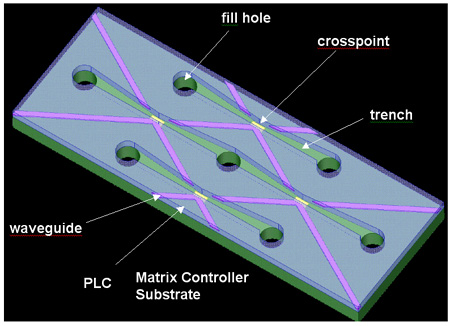
Bubble technology was developed for printers almost two decade ago. In a printer, bubbles of gas created by electrical heating propel droplets of ink toward paper. In the OXC, these bubbles are created in the same fashion but act as a rapidly appear/disappearing optical interface (see figure). The Alcatel device can switch in 7 ms.
Alcatel estimates the OXC addressable market to be about $235 million in 2001, rising to near $7 billion by 2005. Novak says that only an all-optical OXC can keep up with network capacity demands, especially as transmission speeds head to 40 Gbit/s and leave electrically based cross-connects unable to keep up with the need for more ports operating faster.
Novak says the new OXC has a three-stage, standard cross-connect architecture, with easily upgradable electronics, and 3R functions (re-shape, re-time, regenerate). He expects it's dynamic bandwidth allocation capabilities will generate revenue by improving efficiencies and help reduce system costs 40% by lowering network protection requirements.