
Airfiber Launches Wireless Optical Product with Two Customers and Nortel OEM Support
After two years of development, San Diego-based AirFiber Inc. is billing its OptiMesh free-space optical transmission platform as a carrier-grade optical mesh network technology for dense urban areas. OptiMesh connects buildings with no direct fiber access to existing fiber access points in nearby "on-net" buildings at rates of up to 622 Mb/s. The start-up has secured an original equipment manufacturing (OEM) deal with Nortel Networks (Brampton, ON) and trials with Spain's Broadband Optical Access and Kyocera DDI Institute of Future Telecommunications Inc. (KDI) of Japan. The company also
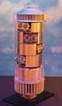
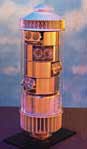 The highlights of AirFiber's free-space optical approach are an asynchronous transfer mode (ATM) mesh architecture, automatic tracking, and short-reach links, explains VP of marketing Janet McVeigh. "Mesh networking and automatic tracking and acquisition is where the patent portfolio is," she says. Each node measures 12" diameter x 35" high for four optical links. Each unit supports 622 Mb/s full-duplex transmission.
The economics of the system are optimized for buildings that need connections with bandwidth between DS-3 (45 Mb/s) and OC-3 (155 Mb/s), McVeigh says, adding that the system proves in for connections beyond three T-1s (1.5 Mb/s each). AirFiber anticipates that OptiMesh will be well received by the large number of competitive and alternative local exchange carriers that seek a reliable, cost-effective, and fast time-to-market option to deliver high-bandwidth capacity (see Figure 1).
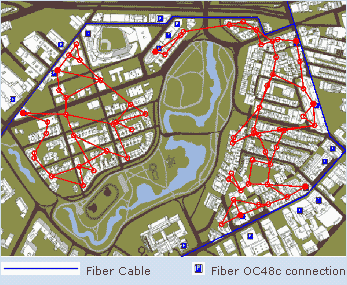
Leveraging an OC-48 fiber ring in blue, OptiMesh links in red indicate access to buildings in a city sans fiber.
Free-space optics incur reliability problems beyond a few kilometers, McVeigh says, so AirFiber specs its system for 99.999% reliable links between 200 m to 500 m, depending on the fog profile for a given city. A smoggy port like San Diego requires 200 m links, while a clear space like Tucson enables 500 m transmission, she says.
Another set of problems that line-of-sight optical networking incurs is building movement and set-up complexity. AirFiber uses a global positioning system (GPS) to calculate the exact position of rooftop units and software to calculate pointing direction. Transceivers rotate 360 degrees (+/- 20 degrees) to find each other. Then a tracking algorithm kicks in to maintain the line-of-sight connection. This allows set-up by technicians within five days of an order without a team of optical engineers, McVeigh says.
The mesh network provides re-routing around temporary signal blockages, such as a traffic helicopter. Point-to-point systems incur single points of failure, McVeigh notes. The OptiMesh units also sport an 8-year mean time between failure.
AirFiber has struck an OEM agreement with Nortel that gives Nortel the right to market AirFiber's OptiMesh products worldwide. Nortel and AirFiber have been working together for the past several months conducting interoperability tests between OptiMesh and Nortel products. The companies are also conducting market trials of the OptiMesh network with customers in Asia, Europe, and North America.
Fiberless networking
The economics of OptiMesh allow carriers to implement a build-then-sell model of delivering high-bandwidth services to urban buildings. The carrier's network operations group can deploy a network "umbrella" over an urban market according to the carrier's penetration strategy and individual market characteristics. Then, the carrier can sell to anyone under the umbrella, confident that the network operations group can quickly and inexpensively provision services.
AirFiber has conducted successful OptiMesh trials with Broadband Optical Access, a metro carrier's carrier founded in January that plans to operate a wireless optical network in Western Europe. Upon the successful completion of the trial, Broadband Optical Access expects to deploy the OptiMesh system to large and medium-sized office buildings in major metropolitan areas.
"The speed with which we can deliver high-bandwidth services to the customer is critical to our company's success," says Francisco Ros, CEO of Broadband Optical Access. "AirFiber's OptiMesh will give us the technology edge to quickly penetrate a large percentage of urban buildings. Today less than 5% of buildings in most European cities have fiber access for high-bandwidth services. We plan to dramatically increase that penetration with AirFiber's wireless optical network and then sell that bandwidth to carriers providing voice, data and multimedia services."
Kyocera DDI Institute of Future Telecommunications Inc (KDI) is evaluating AirFiber's system to provide telecommunications services to companies in Japan as an alternative to fiber optic cable. Tokyo-based KDI is a telecommunications technology research group for DDI, the number two Japanese Telco. A trial in the Tokyo area featured end-to-end application demonstrations such as full-motion high-bandwidth video conferencing.
Upon the completion of the trial, the companies expect KDI to integrate the OptiMesh network with other components of KDI's end-to-end high-bandwidth network and ultimately to deploy this network to customers in metropolitan areas of Japan. KDI cites high-bandwidth wireless transmission capabilities, high network reliability, and economics as the critical factors that led KDI to evaluate AirFiber's OptiMesh technology.
Leasing fiber access from competitors is the only realistic high-bandwidth service option that alternative carriers in Japan have beyond wireless optical systems, AirFiber asserts, because deploying their own fiber network to all their customer's buildings would incur exorbitant cost and deployment time. Optical wireless systems extend fiber-like access to buildings without the cost and time constraints and grants the carrier ownership of network facilities.
By Erik Kreifeldt