
White Paper: Air Force Research Labs wrapped up in fiber

By Jerry Fireman, Structured Information
Table of Contents
Upgrade Bypasses Category 5
Sold on the desktop
Improved network design
Field experience
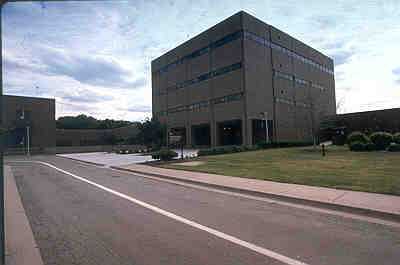
The Materials and Manufacturing Directorate of the US Air Force Research Laboratory is a major research and development arm of Air Force operations. From nuts and bolts to stealth paint, Air Force manufacturing programs and materials production are researched and directed by the Materials and Manufacturing Directorate, headquartered at Wright-Patterson Air Force Base, OH.
The directorate's data network consists of roughly 1,300 network nodes distributed among five buildings at the Wright-Patterson complex. Users conduct materials research with an array of graphics-intensive applications that generate very large files across the network. For example, computational chemistry, CAD/CAM and finite-element analysis software programs routinely churn out files of over 100-MB in size. These files are stored on Silicon Graphics servers and are frequently called up across the network for collaboration by other members of the lab.
Upgrade Bypasses Category 5
Over 200 miles of Volition optical fiber cabling are being deployed among the five buildings as part of the Directorate network upgrade and desktop fiber migration. The lab's existing fiber distributed data interface (FDDI) backbone and shared 10-Mbit/s Ethernet local area networks (LANs), which used copper Thin-net (Category 3) desktop wiring, are being upgraded to a Gigabit Ethernet backbone with switched 10/100 Mbit/s Ethernet to the desk (see Figure 1).
"We decided to skip twisted pair [Category 5] wire and go directly to fiber," says Bryon Foster, senior network manager for the Directorate. The main reasons were unlimited bandwidth using fiber, no RFI (radio frequency) or EMI (electromagnetic interference) to deal with, and much more practical distance limitations using fiber. "Fiber cabling just made more sense as we looked ahead," Foster says. "Then there's cost. By the time you factor the money that you have to add to copper in order to deal with its distance limitations and shielding requirements, Volition fiber costs the same."
Foster's group originally planned on a more limited fiber installation just across the backbone, until 3M arrived with the Volition networking solution. Then it chose to go ahead and completely re-cable to the desktop. Installation started in July 1999 with a backbone upgrade to one building. Essentially a trial run, the other four buildings quickly followed, totaling nearly 13,000 ft of 24-strand Volition brand multimode fiber cable.
The new Volition backbone supports existing FDDI devices, such as SGI servers, using Volition brand media converters. The Directorate is currently evaluating Gigabit Ethernet backbone switches from several vendors, and will connect those devices to the Volition system using 3M's Gigabit network interface cards (NICs) that feature a VF-45 jack (see Figure 2).

Now under way are 19 floors that are divided among the five buildings. Each floor requires about 13,000 feet of 4-strand desktop fiber, with installation proceeding floor-by-floor over several months as funding arrives. "There's no immediate timetable," Foster says. "We started this year with the fiber installation because it's the most fundamental change. As funding becomes available and the new equipment arrives, we'll start activating the desktop fiber and completing the installation on any floors that remain" (see Figure 3).
The existing shared 10Mb Ethernet LANs are being replaced by switched Ethernet. Most users will have a 10Mb switched link to the network, but some users and devices require 100-Mbps connections. Centralized servers, such as the SGI servers on the backbone, will use switched Gigabit links.
The improved longer distance run of fiber cabling versus copper allows the network to be built without multiple hubs on every floor. This saves real estate and equipment costs, and allows more flexible network deployment options. Foster intends to compare two different topologies for feeding desktop traffic to the backbone. The first option is to configure each floor with a 10Mb Ethernet switch, with every floor switch connected by 100Mb uplink to a Fast Ethernet switch in the building. The 100Mb building switches will then feed the Gigabit backbone.
The other option is to connect each floor directly to the Gigabit backbone, using a Fast Ethernet uplink. "We'll monitor the network to see what works best," Foster says. "Right now, if we lose one switch then we lose that floor, but if we lost a 100Mb building switch, then we'd lose that whole building." However, with multiple uplinks and load balancing between switches, it should be possible to deploy a fault-tolerant switched hierarchy from 10Mb to 100Mb to Gigabit nodes. The Volition fiber cabling itself can easily accommodate any network design.
Field experience
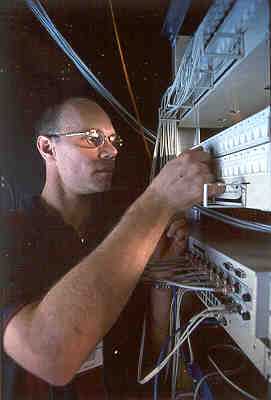
"The learning curve was very short, as quick as could be," says Sylvester S. "Bud" Lucas, Manager of the Wright-Patterson Field Service Enhancement Team (FSET) 88th Communications Group that handled the installation. The FSET has installed thousands of feet of fiber with traditional ferruled connectors for other Air Force projects over the years, and so approached the ferrule-less Volition system with somewhat jaded expectations.
"We have people on the team with 20 or 30 years of field experience," Lucas says, "so the technician that 3M sent out to lead the Volition training was up against some serious expertise." For example, setting up a system to test the installation using the FSET's existing test equipment was a major requirement. Volition cabling can be tested by using patch cords to connect to any test equipment, but the configuration varies among different systems.
Whereas traditional fiber optics are tested one fiber at a time, the Volition system is a full-duplex technology that requires testing of two fibers at a time. The FSET was concerned that its Microtest CertiFiber system could not reference two fibers simultaneously. The solution turned out to be straightforward and simple - 3M's field technician showed the team how to configure its CertiFiber system to connect test jumpers to pairs of fibers at a time.
In the end, the Volition cabling and termination posed no difficulties at all. "The terminations are fast and easy, and the cabling itself is about half as bulky as other stuff we've used," Lucas says. "The fact that it takes up half the space is a major feature--making the installation that much easier to work with."
For more information contact 3M Telecom Systems Division, 3M Austin Center, Building A130-2N-01, 6801 River Place Blvd, Austin, TX 78726-9000 Phone: 800-695-0447 Fax: 512-984-581. Visit the 3M Volition Network Solutions website at http://www.3M.com/volition. 3M, Volition and VF-45 are trademarks of 3M.
About the author…
Jerry Fireman is a technical writer with Structured Information, Birmingham, Michigan.